Tuesday, 7 May 2013

The end of the line

Our trip is now officially over.  We have reached Ushuaia, the farthest south point you can reach by road in the world.  We can tell because there are lots of postcards saying that and also it is quite cold.

For anyone who thinks we have moved prettty quickly, you're right.  We spent a couple of days in Valdivia, hiding from torrential rain by drinking strong German beer and spending time with our very lovely couchsurf hosts.  After that. some lucky hitching and another dose of white line fever have meant we've covered about 2870 kms (1780 miles) in the last six days.  But the thing about Patagonia is, there's basically nothing here in the vast majority of it.  Gloriously, breathtakingly, nothing.


In lots of ways it's kind of like Scotland.  As we crossed over from Chile we got in some hiking in dripping woods


and watched the terrain change to mountains and autumn foliage


full of blue-green lakes and ski resorts.

Farther south, everything turns to brown grass and wind-stunted trees.  It began to get really cold, causing C to go into hibernation mode


The nutrition in the grass is so poor you need 5 hectares to raise a sheep.  Most farms have at least 5000 sheep to make a profit and that gives you an idea of the scale of them (the farms.  The sheep are quite stunted like the trees).  The sheep still manage to get in the road of course, and they are about the only thing blocking the freezing wind whistling across from the Andes to the Atlantic.  We have also seen rhea, the native flightless bird, and guanaco, the llama's far more dignified cousin who roam about down here laughing mockingly at the pathetic human fences and effortless leaping them to go wherever they want.

The crucial difference between here and Scotland though isn't even the small ostrich type creatures or camelids.  It's the size of the place.  Patagonia alone is twice the length of the whole of Great Britain and much wider.  So its size in terms of Scotland is hard to countenance.  There are spaces between towns the size of Scotland.  All this means when people do pick you up they are often going pretty far.


Once in Argentina we headed south through the alpine-esque towns of El Bolsón and Esquel to Comodoro Rivadavia.  There, after a slightly chilly and uncomfortable night camped out, we were filling our flask with hot water at a petrol station (hot water dispensers are at all fuel stops because if Argentines can't constantly supply themselves with Yerba Mate(1) they may riot.  More on this later) when a friendly looking chap approached and asked where we were going.

"Scotland," we brightly informed him in a minor Spanish fumble (Where are you from is a much more common question and they sound similar).  He looked a little confused as to how we intended to backpack there but after we realised our mistake explained that he would shortly be headed south to Rio Gallegos, about 700kms south.  Of course we jumped at the chance and were soon flying through the night chatting away(2) and drinking Yerba Mate.

We've had Yerba Mate from over half of our rides here.  We'd heard of it in the UK as it is a bit of craze in some circles there, but had never tried it.  You can't avoid it here though (where it is from.  Apparently Paraguay and Uruguay are the same too).  People travel with their own special little gourd which they fill with the strong bitter herb and then gradually pour small amounts of water at a time.  You drink the water through a special metal straw with a filter, refill and pass the gourd to the next person.  It's a strong flavour but great in the cold and we can't emphasize enough how essential it is to the culture here.  Last night our lift kept refilling it so often we both had to beg him to stop so we could pelt to a bathroom while he sat in the car giggling and apparently immune to the amount of liquid we'd consumed.  We suspect Argentines of having a special second Yerba Bladder.

We slept that night in a bus station behind what was technically a picket line.  A week long strike of long distance drivers has only been lifted today.  It was not as exciting as it sounds and it took us several days to notice the strike anyway as it never occured to us to take buses.  It seems that the unions have got something out of the big business, so that is good news.

Our hitching continued successful and we crossed into and back out of Chile (this guy was the border guard


), took the ferry to Tierra del Fuego and arrived in Ushuaia in the early hours of this morning.

So there you have it.  We have reached our destination.  It is certainly much nicer than Deadhorse.  We have traveled two continents, 15 countries and over 20,000 miles (31,000 kms).  That's more than going from Madrid to Bangkok via Moscow and back again.  All in all we're a bit knackered but very happy.  We are currently in a lovely little library full of big sections of books and friendly staff because internet cafes here are insanely expensive.  But here it is free.  Libraries have done us proud since Alaska.(3)

We don't fly home until early June and have to get to Buenos Aires to do so, so we will be faffing about some more for about another month, and still blogging if you're into that sort of thing.

------

(1) Pronounced Mah-tay.  There's no reason why anyone who doesn't speak Spanish should know this but J still got sneered at (despite speaking a little at the time we didn't know it was from South America and that that pronounciation applied) in a swanky coffee place in Portland for pronouncing it like the affectionate term from London... we told you it was a craze for the cool kids.

(2) Though they replace 'Y' sounds with 'Shh' sounds as in (Shho soy C y estoy en Argentina con shhamas, poshho y shhuvia) the Argentine has actually been easier for us than the Chilean one often was.

(3) Support your local libraries folks.

Monday, 29 April 2013

Autumn has come

We escaped the route 5 to Elqui Valley, home of Chile's grape brandy Pisco and many observatories, purely by coincidence.  There we had some cheap, tasty vegan food (there is also a New Age colony in the valley, presumably after some different spirits) and arranged to go up to an observatory for some sky-gazing.  This was unfortunately cancelled due to clouds, which was a shame but we are sure it couldn't have been better than the night we spent on California's route 1 anyway (except for the Southern Cross of course) and it was a pretty day-trip in itself.

Back on the road we hitched on down to Santiago and bought our little electronic Bip card for the transport system.  This is the same as Oyster cards in London except without the option of just paying cash for the buses, which can leave you kind of stuck in large parts of the city not covered by the Metro trains.  Anyway, we met up with our lovely CS hosts and asked them how on earth they managed to stay vegan in the Southern Cone, where nearly all bread you buy in the supermarkert contains lard (for reasons we're unsure of since bread doesn't really need bulking). 

In exploring the city itself we wandered up the eccentricly developed Cerro Santa Lucia near the heart of the city, visited and recommended by Charles Darwin (which is more than can be said for Tierra del Fuego, but we find out for ourselves soon enough).


It is a very pretty knoll, covered in turrets and towers of half a dozen architectures with views as good as Santiago´s smog-bound horizon will let you see.

We generally took it very easy in the city.  Autumn had appeared out of a cloudless desert sky and J was thrilled to get the foggy mornings, red and gold trees and grape-vines, visible breath and roasted nuts the season demanded (and that we had missed this year what with being in Mexico).  Leaving aside the usual city things we saw, Santiago had the fattest street dog we had yet seen.


There, you won´t see that in the guides to Chile but equally you won´t see that fat a street dog elsewhere.  He seemed very content.  We´ve been having a problem with street dogs recently where they seem to identify us as their own, to the extent that a pack of 6-7 followed us for several kilometres out of town recently.  We don´t know what the secret signal Chilean people give them so that they ignore them is and we showered recently and everything.  It is a mystery.

We also visited the Museum of Human Rights, built in memory of the coup of September 11th 1973 and subsequent dictatorship. (incidently, this is the reason Chileans might be a tad unsympathetic to any Americans who expect global sympathy for their "9/11" given the massive effort America put into putting Pinochet in power).  Despite the ridiculous building it is housed in we really enjoyed the museum, as much as you can given the topic.  However we felt that by beginning at 6am on Spetember 11th, they had kind of avoided any looking at where the coup came from, or the actions of the Allende government in the preceding years.  Also by focusing on an individual "baddy" like Pinochet, all complicated questions about the support from mining compnaies and large landowners or the international support of Reagan in America and Thatcher in Britain, could be ignored.  And of course, the indiginous Mapuche didn´t get even a mention as far as we could see, let alone mentioning the post-Pinochet government never gave them the land he took back.  But it was free and we would recommend it if you can read Spanish.

The fact that it was in Spanish was interesting as we felt it was a sign that museums were more focused on national visitors than international ones, the mark of a richer nation maybe.  Despite much of the music in bus stations and on radios being in english, almost no one speaks english and much of the tourist info we have seen is in Spanish.  We think it maybe explains why Chile is less of a tourist hole than Costa Rica or Bolivia (we can´t speak for San Pedro de Atacama of course), but it has made us really glad for the Spanish we have learned as we would otherwise be extremely limited travelling here.

Despite really enjoying eating and cooking vegan with our hosts, we also really enjoyed visiting the fish market in Santiago, we you can see all the fresh seafood brought in each morning and then eat it at the many restaurants.  We splashed out on probably the most expensive meal we have bought on the trip (USD $25 for us both) and J had raw sea-bass, mussels, sea urchin and misc. marinaded in lime juice (which "cooks" it by oxidation) and C had red conger eel grilled with lots of garlic.  There was also two glasses each of pisco sour and seemingly limitless bread rolls shaped like fish.  It was a real change from our norm and a great meal, since despite being from a fishing port (Aberdeen), seafood other than fish and chips is nearly non-existant (except for silly amounts of money).  Though we are looking forward to people buying us chippers (or chippies as the English say) when we return. Just saying.

Moving south of the capital, we hit something of a hitching snag, waiting for about five hours outside of Chillán.  While we've faced long waits before, the disturbing thing is the blank look on people's faces as they drove past us, which is normal for the UK but very unlike the rest of Chile so far.  The foggy chill makes waits more of a challenge than they were in Panama or even Canadian summer time as well.  But we escaped the Chillán trap and have got off the Route 5 again to Villarrica, on the imaginatively named Lago Villarrica with amazing views of the Villarrica volcano.  Our rides were even nice enough to stop and show us the Salto de Lajas waterfall along the way.


It's no no as impressive as where part of J's family is currently exploring (look here for more info on a very exciting trip for some lovely ladies), but it was very pretty and the kind of little thing we sadly often skim by, since we lack control of our own vehicle.  Though we in no way miss road tolls, taxes, petrol prices or even the idea of taking one vehicle through many countries.  We'll stick by our thumbs thanks.

Sunday, 21 April 2013

White Line Fever

The title is a phrase we heard from a biker we met in Panama to describe the traveler's itch.  Over the last week we've certainly had it, covering about 2500km (1500 odd miles).  Most days there's been nothing we'd rather do but keep hitching.

However, hitching wasn't an option from Uyuni to Chile.  After a whole day's frustration we realised we would have to get the bus.  We then learned there would not be a bus for two more days.  Instead we went to Argentina.*  We crossed over at Villazòn  and saw our first real signpost for Ushuaia, a mere 5,700km.  Of course we wouldn't be taking such an easy route as that.

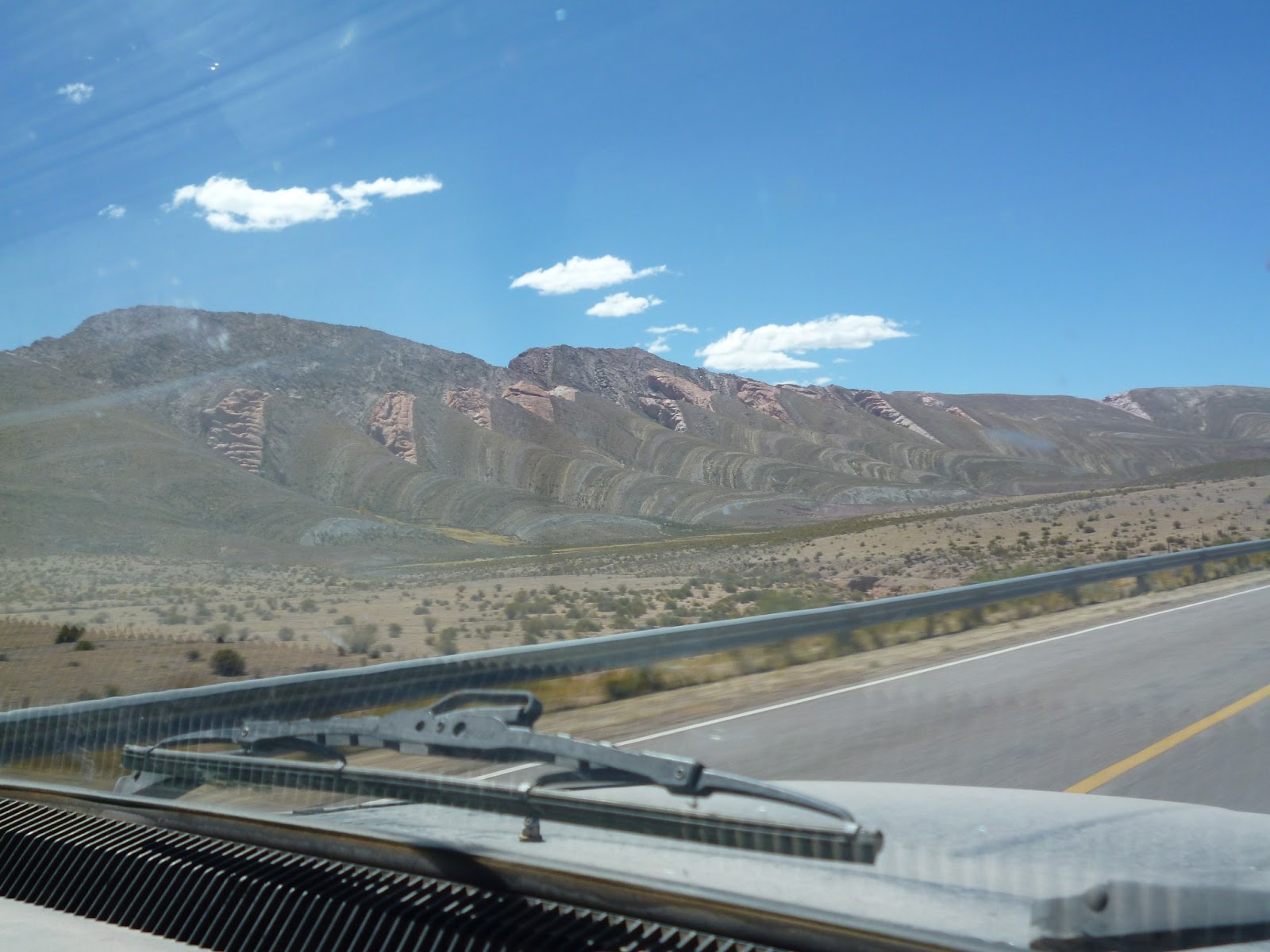
Our first day was one of great rides and beautiful views, both whilst driving


and at hitching spots


The road that ran into Chile was a major one for trucks coming to/from Paraguay and Brazil and the tax-free zone in Northern Chile.  This was good news for us (though bad news for Paraguay, it doesn't produce anything and hasn't since 1870) and we coasted easily through the mountains, as marching armies of cacti surrounded the road, giving the impression of having frozen, arms raised, just as you looked at them, like a huge game of What's The Time Mr Wolf.

Our first night in Argentina was spent camping and symbolically drinking Argentine wine.  It is hot in the daytime up in the Altiplano and the altitude puts you at real risk of sunburn, but once the sun goes down it gets cold.  We got a great ride through the Argentine/Chilean border, which was a very stupid border indeed and we kicked our heels there for several hours.   We passed straight through the tourist hotspot of San Pedro de Atacama and were in Antofagasta by nightfall, having gone from over 4,500m above sea level to the coast in one day.

Apart from San Pedro, the north of Chile is functional mining country.  It feels like being back in Canada.  The same pick ups, the same boots on the men standing around (doing that manly rocking about on their heels discussing large lumps of metal thing), the same desolate landscapes peppered with towns full of nothing but grids of houses, small shops and the the odd grimey strip bar.  With the exception that here in Chile towns that used to serve the same function for nitrate stand empty, ruined and half swallowed by the desert, a warning of what happens when the resources run out.

There is not much to do in Antofagasta.  It is the most expensive city in Chile but without much to visit to justify that unless you have a very highly paid job in a nearby mine.  We did meet another traveler though and together found a cluster of other hitch hikers, casual workers and hippies camping on one of the beaches.  As it took us a while to get going in the morning we ended up spending a full day there, making and selling our little flowers and drinking Chilean wine (well, it's even more famous than Argentine after all).  We soon adopted a small crowd of sixth formers who we made late for school exchanging Chilean recommendations of music and film (look up Los Bunkers for some sixties inspired Chilean rock that we liked) for teaching them English swear words and how to make the flowers.  After a night on the beach,


the next day, Friday, it was definitely time to get going again.  The hitching continues easy and friendly here and we were surprised to find ourselves in a truck going all the way across the desert.  Unlike the glimmering salt flats or the shifting golden sands of the Sahara, the Atacama desert was brown.  That made the effect all the more uncanny as it looked like normal dirt and hills from back home, just dirt and hills on which not a single moss or insect lived for hundres of miles.  We love deserts.  We arrived in La Serena in the early hours of Saturday and found our first couchsurf in weeks.  We have fallen on our feet with an incredibly friendly and welcoming family who are looking after us with showers, beds, good food and more wine, and letting us play with their pack of hounds.

Today we visited a museum of archaeology and saw some of the Rapa Nui (Easter Island) heads and a lot more about precolombian Chilean cultures.  La Serena is pretty sleepy on a Sunday so we will be chilling out for a while before we get going again tomorrow.


----------------

*An alternative title for this post was "We've come to Argentina by mistake, are you the farmer?" but this was limited to those Withnail fans who are laughing already. 

Sunday, 14 April 2013

The Altiplano

Cerro Rico (´Rich Hill´, the conquistadors were too overcome with lust for silver to get imaginative on the names) looms over the city of Potosí and can be seen from everywhere in and around town:


When the Spanish arrived, they soon discovered that you could literally pick the silver off the ground.  In the 16th century Potosí was richer than London and bigger than Madrid.  The money never stayed in Bolivia though, let alone Potosí.  The wealth of the mines is long gone now and the town is poor with nothing but ornate colonial buildings to remember the past.

Despite the depleted amounts however, the mines still function, mostly in the control of co-operatives of miners.  Wages are better than anything else in town but that is not saying much, and the health risks are high.  You can tour the mines and though we were hesitant about them as a tourist destination we found a company staffed entirely by ex miners who seemed very down to earth, and decided to go for it.

It turned out very informative and the miners at work, like these guys pushing a trolley,


 varied between being indifferent to our presence to laughing and joking as they accepted the juice and coca leaves* our tour bought as a present.  We discussed politics for a long time with our guide, a big-hearted and interesting guy who had worked the mines for four years starting when he was just twelve.  He was very pleased to hear about Margaret Thatcher.  Hem.  Don't think we need to add anything there.

We also met 'El Tio', the devil like creature the miners claim is in charge down under the mountain, as it doesn't seem like God could have anything to do with it.


Other than the mines there is not a lot in Potosí.  We spent our other day at a volcanic hot pool (22 metres deep so safe for diving)


and then hitched out to Sucre, thumbing for about 20 seconds before some smiley guys in a pick up pulled up and tossed us in the back.

Sucre is beautiful but unless you are volunteering or studying Spanish there is not a lot to do there.  We took a gorgeous hike out to some waterfalls and pools and swam


and found a cinema showing Latin American films with English subtitles.  One was an interesting depiction of corruption in the Buenos Aires police, and the other a documentary about a boy working in the Potosí mines- The Devil's Miner.  Though it was maybe a bit heavy on the sensationalist aspects of El Tio and a bit light on the economics of why there are kids trapped in these lives, we'd definitely strongly recommend it to anyone interested in finding out more who doesn't happen to be hitching through Bolivia.

After a museum visit and some strolling around the pretty streets, we were ready to leave Sucre.  But we also collected a friend, the lovely M from Canada who we had met in La Paz and is now volunteering in Sucre.  She was keen to take the weekend to visit the salt flats at Uyuni with us.  We found hitch hiking just as smooth with three and made it back through Potosí and on south to Uyuni in a day.

The norm seems to be to get a tour to the salt flats, but M's friend had given us a tip on how to just get a local bus out to the edge and then hike around.  We skipped some natural spots and could not go far, but even apart from the money saved we are really glad we took this option.  The flats are the largest in the world, and in our mere dabble in the edge (we walked straight in for an hour and a half) the fact we were hiking really gave it a sense of scale.  The distances are deceptive and shimmer before your eyes and the crystals and patterns are breathtaking.


Before we came to Bolivia a few people who had been here complained of the unfriendliness of the people.  So far we have to say we had experienced no such thing, including easy hitching and helpful passers by.  But suddenly in Uyuni we see what they mean.  People ignore you or are flat out rude and refuse to serve us for being tourists.  It doesn't feel nice.  It's unlikely of course that people are just randomly nasty and prejudiced in this town, more likely tourists are obnoxious or the tours of the flats (which is the only reason people come) benefit only a few people in the area.  But whatever the reasons, none of them inspire you to stay.  Tomorrow we say goodbye to M and strike out for Chile.


*Coca is ubiquitous here.  Yes cocaine derives from it but they are very different and coca is no more addictive than coffee.  Miners use them to give them energy and supress hunger as it is not good to eat down in the mines and they also make a rather delicious tea.

Sunday, 7 April 2013

Madidi National Park

First of all we should mention that the wrestling was actually a lot of fun.  I mean, we got to watch two hefty women in bowler hats beat up a clown.  How often can you say that?  The crowd and wrestlers threw a lot of tomatoes at each other and at one point that same clown sumersalted over the barriers and onto our laps.  Also you get to watch the crowd, with little old ladies leaping up and down giving the finger to wrestlers.  A show in itself.


Then we set off on the bus for Rurrenabaque.  It's a twenty two hour journey with no toilet on the bus, so we were a bit concerned but they actually make a few stops along the way.  The mud piles and wild sliding near the edges of huge ravines was a bit more worrying, but credit to the drivers they all just keep going and get there in the end.  The negative thing was that along the way our rucksacks had become soaked in petrol.  We mean really soaked.  This was sad and upon discovering the extent of it we ended up putting almost everything we had, including tent and rucksacks into a laundry place, who were very understanding and promised to do their best.  To be be completely honest we actually spent the first night in our tent before adding it to the laundry.  However such is life and we've been travelling long enough not to let such upsets take away from being near the Amazonian jungle!

The next morning after a delicious and restorative breakfast of stuffed fried yuca balls and tasty juice of unknown fruit, we boarded our boat for a three hour journey along the Rios Beni and Tuichi to the lodge.  There are many tour operators in Rurre, going to both the national park and the pampas wetlands.  We went with Madidi Jungle tours.  Three different peoples have shared access to the park and this group is ran by the indigenous community of San Jose de Uchupiamonas, which is the only settlement in the National Park.  It wasn't the cheapest but a number of groups have reports of abusing animals (especially in the pampas) and here the money stayed with this local community so we went with them.  Everything claims to be eco these days but the genuine article is often easy to tell.  So we went up river entering the park through a gorgeous moutain range

and arrived in time for lunch.  The food throughout our stay there was delicious, particularly the catfish cooked with ginger and herbs in a big leaf.  And yuca patties for breakfast.  Sometimes you do get what you pay for.

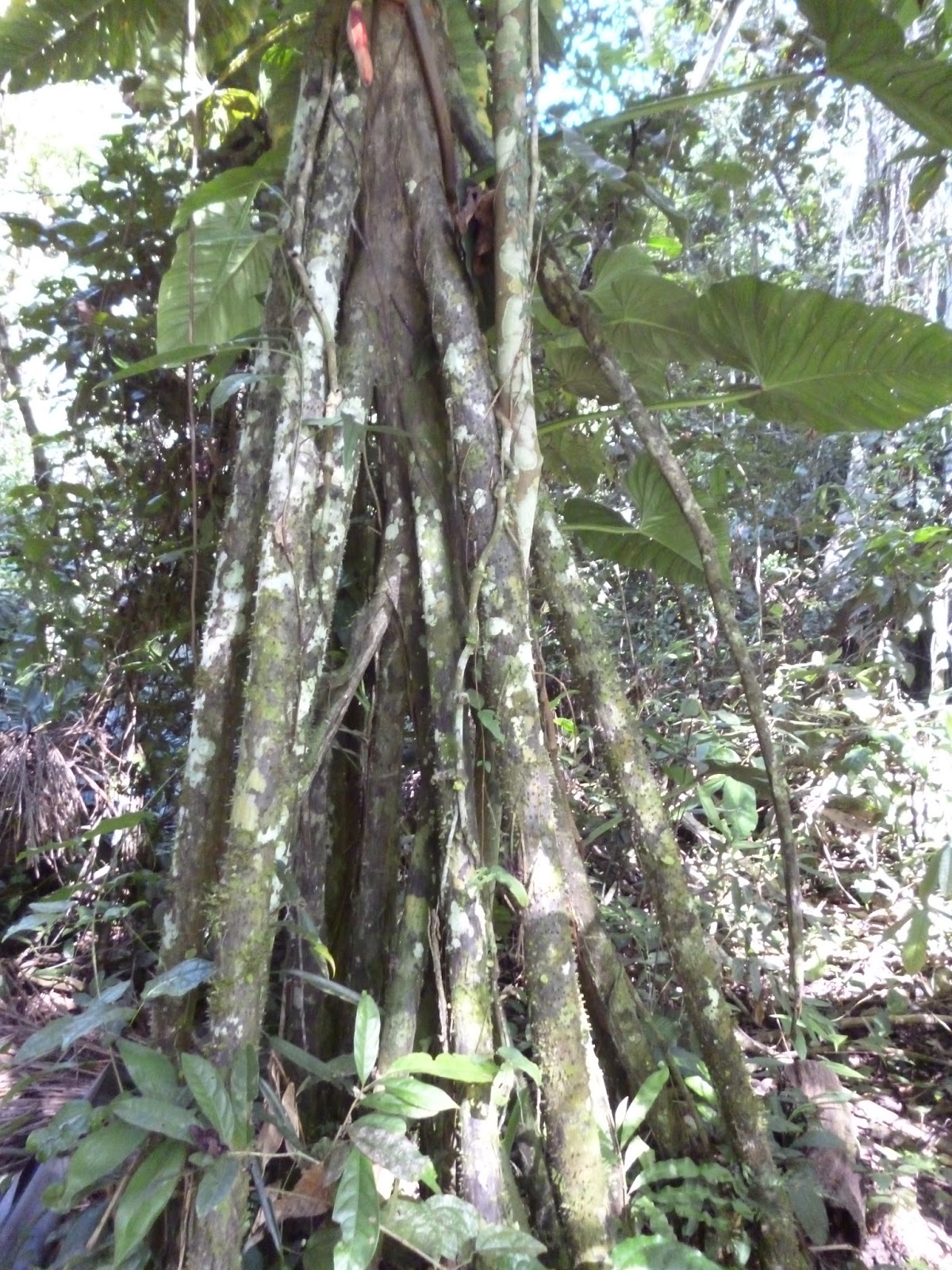
We went on two day walks, one night walk and had a relaxing float on innertubes down the river before we left the next day.  The forests were teeming with life; we saw peccaries (which are not subtle), black spider monkeys, red and green macaws, a variety of spiders, snakes, catepillars and butterflies, fer-de-lance, white hawk, capybaras and more.  But the forest itself was amazing, the symbiotic network of life, from walking trees, which when overshadowed let the roots most shadowed die and put out new ones in the direction of sunlight, thus "walking" for metres across the forest.

Or strangler figs which arch up for the forest like arboreal pythons to grasp and wind themselves around other trees, growing larger and wider until the surround and kill the tree within.  The living, tingling dynamic of the forest, where walking trees outrun stanglers and others have developed easily shedable bark to deter them, while yet other trees are the skyscaper of choice for fire ants, their hide pockmarked by nests and the sheen of vicious biting insects.


Our guide was very nice and knowledgable, and the whole thing was conducted in Spanish which makes us feel good about our language skills.  Out of big cities and in areas with more indigenous people you start to feel very smug and fluent, as they speak a clear Spanish which is often a second language for them too after their own.  Then you go back to a city and can't understand directions to a burger stand.  Hey ho.

We spent one more night in Rurrenabaque to wait for our laundry and boarded a bus back to La Paz - we went with a different company.  These guys were pretty on it and we were rattling along at a good pace, the roads much drier.  Sadly rockfalls do not pay heed to this kind of thing and one blocked the road causing us to be a full 12 hours late into La Paz.  But we were stopped next to a fried chicken shop and a beautiful river to cool off in so it wasn't exactly wilderness survival.

You can fly to Rurre.  It takes about an hour and a half.  But apart from the insane increase in price it just seems a bit strange, to take a short haul flight to one of the world's most delicate ecosystems.  Isn't that possibly self defeating and at best just selfish?  Also, you're going to the Amazon!  It should be an adventure otherwise it doesn't count.

Arriving so late back into La Paz we nonetheless caught the last bus to Oruro with seconds to spare.  This took us south again of places we have been and into new territory, a feeling we cherish.  And first thing in the morning from Oruro we started thumbing a lift (we had not yet done this in Bolivia which gives us the slightly irrational but very strong feeling that it doesn't really count as having traveled in that country yet).  We were headed for Sucre, the actual capital though everyone ignores it in favour of La Paz.  Two very friendly rides later, with no long waits, we are safely tucked up in a hostel in... Potosì.  In our defence, we have been hitching without a map a great majority of the time since Mexico.  And it has only now lead to this kind of confusion.  But its ok because we wanted to visit Potosì anyway and can just loop back around to Sucre afterwards.

Sunday, 31 March 2013

La Paz

The city looks a lot larger than it is by the fact that when you are in the valley of the central city you can see the buildings crawling up the steep cliffs like concrete ivy in all directions.  It´s not a pretty city, but it is in a pretty place, snow capped mountains and lunar cliffs are never far from eyesight and every so often a normal street gives you a panaramic view of the Andean surroundings.

It´s also a really lively city.  Unlike Quito, the streets are full of people and market stalls well into the evening.  People had warned us that the food wasn't very good in Bolivia and while it's true there is quite a lot of hamburgers and sliced hot-dogs with chips (in the british sense of chips), there are numerous tasty things such as the stuffed potatoes we found in Cusco and Api which is like chicha morada but hot.  OK so we ran out of things.  The food isn't Bolivia's crowning glory, but everything is SO cheap it's hard to care.  Also bottles of local wine only cost two pounds.

We've been enjoying local markets.  There is one in a poor district high on a hill above the centre (here the rich districts are lower down because it is milder), which only happens twice a week and sells EVERYTHING.  Really, everything.  Clothes, cosmetics, army surplus, books, films (from Bollywood to Korean), games, power tools, tyres, bits of cars dismantled, unexplained metal things, things that look like they have just been nicked, food, etc etc.  It was also huge, we wandered for over two hours and didn't see it all, and insanely cheap.  Back in the centre near our hostel, there is the Mercado de Las Brujas (Witches' Market), which sells weird cures and items for ritual offerings, including these dried sea-horses and llama fetuses.

We've also got out of the city a couple of times to hike the Valle de la Luna park, where different periods of rock formations have made a moon-like area


and the Muela del Diablo peak, not far from the city but a beautiful walk, with great views of La Paz.


We found a cafe run by Mujeres Creando, a very cool feminist collective who have also covered the city in graffiti and we enjoyed a meal there of Pesk'e (which is an unusual hot combo of quinoa, milk and cheese.  As we said food isn't Bolivia's thing.)


This is the cafe.  You can tell they are lesbian llamas because only women wear those hats.  Hurray!

Other strange animals we have observed are La Paz's Socially Conscious Zebras (SCZ).  It started when they were helping people cross the road, which given there are no actual crossings made sense (Zebra crossings get it?).  But then, we saw wall paintings of them helping children with homework and gardening and saw increasing numbers of SCZ roaming around


Then one night, it culminated in a collection of SCZ waving banners about brushing your teeth or choosing to be happy putting on a show in a main plaza with a drama group, an orchestra and break dancers.  It was weird.  But at least it seems they are getting some use out of out-of-work actors because the SCZ were all so enthusiastic and hammy.

We also briefly visited the National Museum of Art.  They were having a big display of gender equality posters from around the world, some of which were quite good


but then you entered the salas and found a bunch of paintings done by old men depicting women only occasionally as either saints or boobs.  But hey ho can't have everything from art museums... wouldn't have killed them to have thrown in a radical anarcha-fem lesbian llama though would it?! 

Tonight we are off to see some wrestling.  We never saw any Lucha Libre in Mexico and Chile (the next place where this is a big cultural thing) will be much more expensive than Bolivia.  Plus here, a lot of the wrestlers are traditionally indigenous women, which is a bit different.  So even though wrestling is not usually our thing, we are gonna give it a go.

Tomorrow we head for the Amazon to be proper tourists in an eco-lodge.  More on that afterwards.

Monday, 25 March 2013

Lake Titicaca and Thereabouts

Looking for missions that would take us out of Cusco while we waited, we went to more ruins, this time at Tipon, which is thought to be a fancy royal estate (because they have no clue and it is pretty).  It's most notable feature is a complex series of water canals and miniature waterfalls.  The first thing we noticed is it is located up 4km of steep switchbacks.  Still it was a really nice site to relax at


The day before we had been debating finding somewhere cheap/free to sleep, we happened to ask the owner of the hostel we had been staying in.  He said we could camp for free in the garden of a house he was renovating.  Not only was it free we had excellent views over the whole city at night.  Win.

We met up and spent a nice afternoon evening with our Quebecois enjoying the market, the herb cheeses, the tamales (which are really good and come in savoury and sweet varieties) and other things one last time, endured a massive tropical downpour and in the morning were happy to leave Cusco and get back on the road


Still travelling with our friend AR, Peruvian hitch-hiking remained kind and we reached Juliaca and bedded down for the night in the huge bus terminal.  However before we did so, we enjoyed a huge bowl of chicken broth, with lots of chilli onion mix to add as desired.  We've all been a bit stuffed up with cold recently and this was the perfect medicine for that.

The next day we went out to the beautiful grave sites at Sillustani.  Though we were going for the ruins, we were amazed at how beautiful the nearby lake was and all the small stone compound type homes in the area, with pretty arches and good luck cow statues on the rooves.


We did some more gorgeous hiking and camped there (again for free) for the night.  However we were now about 3800m above sea level and the while the stars were pretty, the clear night left us shivering.

Puno is the Peruvian gateway to Lake Titicaca and numerous islands.  It's also a pleasant, cheap, lively city with several markets and 2-3 sole (50-75p) two course menus.  A friend of AR´s had recommended Taquile Island as a place to hike and we decided to tag along.  The ferry took about three hours to reach the island, helping us appreciuate the sheer size of Titicaca. Along the way the boat stopped at one of the 'floating' Uros Islands, which are made from layers and layers of reeds with reed houses atop them.


It was interesting to see how they make the islands, but kind of a strange place to be.  It seems the island you visit is more of a display and doesn't look actually lived on, and you are immediately surrounded by people trying to sell you artesanias of various kinds.  A combination of bag space and Scottish/Yorkshire heritage means we almost never buy souvenirs and when we do they have practical uses.  But it's a dynamic that makes you uncomfortable.  And so it should.  Compared to the Uros Islanders, any tourist is rich and privileged, usually directly because our economies Take All The Things from their type of economy.  But aside from the issue of not being able to buy from everyone, it doesn't feel to us like its the way out of these situations anyway.  Tourists can only come and buy these things whilst we are all richer than the artists in question.  Any actual redressing of that inequality and they would find their economy no longer has a base.  We've taken away all autonomy and power from these places but told them it's ok, they can be just like us and rely on consumerism for everything.  We'll toss them just enough crumbs that they can remain romantically poor.

Taquile itself felt like a  much more genuinely inhabited place.  The colours of the stunning blue lake and the red tin rooves and the labyrinthine network of stone dykes that covered the island made for some gorgeous hiking, even with our tortoise-like pace up the hills (it´s the altitute we swear).


The second day we even found a beach to enjoy a brief swim.  The lake looks crystal blue and inviting but is freezing.

It was during this time C finsihed The War of the End of the World by Mario Vargas Llosa, a Peruvian author.  As we´ve mentioned we have been looking up some Latin American authors and books while we are here and WotEotW is the best Latin American fiction C has read yet. A novelisation of a real war, don´t look it up or you´ll spoil the plot, but do read it!

Returning to Puno, we napped in another large 24-hour bus station (it´s quite common here, kids and families waiting for a morning bus etc) and set off to an Incan fertility temple in Chucuito, although since it wasn´t built on a hill, lording it over everyone else, we are suspicious as to its Incan authenticity.


But it's really very educational and interesting, and anyone who giggles at this is obviously much more immature than us.

It was after this that we parted company with AR.  It was fun travelling with someone else for a while as it makes a change.  We set off for the border and after smooth process we were in Bolivia!

Bolivia is somewhere we have both wanted to go for a long time and it felt really good to have made it.  Copacabana is the Bolivian gateway to Titicaca and is the original that the Brazilian beach is named after.  It is also home a very important pilgrimage site, where people walk the 200km from La Paz over Holy Week. Fearing we might be trapped by road closures for this we decided to get a bus that night to La Paz.  This was fine with us, as we had already eaten some delicious, battered, tiny lake fish called Ipsi and Copacabana was a much more tourist-filled place than Puno, and we were struck by the sheer number of signs in English advertising wood-fired pizzas and vegetarian menus.  So we didn´t feel very tempted to stay longer than a couple of hours.

During our time in and around Lake Titicaca we heard several different explainations for the name.  We were told that 'Titi' means cat in Quechua and 'Caca' means grey in Aymara.  We were also told that this name referred to;
1) A big gray rock shaped like a puma on Isla del Sol (Incas were always seeing puma in everything)
2) A legend about the creation of the lake involving a crying Sun God and some bedraggled survivours
3) If looked at upside down from space, the lake is the shape of a cat (it isn´t)

Anyway, we were really pleased with all the hiking and things we got done over the last week or so, but feel like a break from old stones and camping for a little a while and are looking forward to exploring the massive sprawl of Nuestra Señora de La Paz (highest capital city in the world, except it´s only the de facto capital, which makes the claim a little bit qualified but there you are).